
Purpose
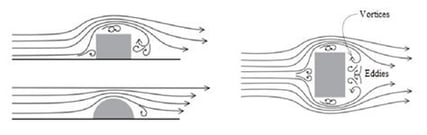
This short guide explains why the location of a wind sensor strongly affects measurement quality, gives straightforward placement guidance, summarises common regulatory expectations, and explains how to manage situations where an ideal location is not available. Include your airflow illustration in the “Why the location matters” section to show disturbed flow around obstacles.
Why the location matters
Wind sensors measure the air where they are mounted. If that airflow is disturbed by nearby structures, towers, railings or deck levels, the sensor may read lower mean wind speeds and report rapidly changing directions. That disturbed airflow (turbulence) can extend a surprising distance: as a rule of thumb, a structure can affect flow to roughly twice its height upwind, several times its height downwind, and up to twice its height above the structure. A small obstruction can therefore spoil readings over a sizeable area.
Note on sensor type — ultrasonic vs mechanical
Ultrasonic and mechanical (rotating) wind sensors react differently in disturbed airflow. Mechanical sensors visibly spin, stall or oscillate when flow is disturbed — a quick visual cue that the mounting is compromised. Ultrasonic sensors have no moving parts and do not “spin”, so they can continue to report plausible-looking values even when the airflow is disturbed. With ultrasonic sensors, check the data (variability, gust/mean ratio, direction scatter and quality flags) rather than relying on visual inspection.
Good practice for sensor location
-
Choose the most exposed location you can reasonably reach. Higher and clear-of-obstructions is usually better.
-
Avoid mounting in wakes or recessed areas. Don’t place sensors directly behind structures, within recessed wells or amid railings where eddies form.
-
Follow manufacturer guidance. Sensor vendors publish recommended clearances and mounting instructions to minimise local disturbance.
-
Protect from work and fouling. Activities like painting, welding or grit-blasting can contaminate sensors — protect and inspect sensors after such work.
-
Plan a verification visit. After installation, arrange verification to confirm the sensor provides usable data in the operational environment.
Regulatory considerations (height and reporting)
Many aviation and helideck regulations (including ICAO Annex 3 and IOGP/CAA helideck standards) expect wind to be reported at a reference height — commonly 10 metres above the helideck. Check with the relevant authority to confirm the current requirement applicable to your site. If a sensor cannot be sited at the reference height, projects typically agree a controlled approach that may include a documented scaling method and an on-site verification to demonstrate the data is suitable. Record any scaling or assumptions used for regulatory reporting.
Multiple sensors and managing non-ideal locations
Some sites use more than one wind sensor for redundancy or to provide different views of the local wind field. The main point for customers is correct placement: each sensor should be installed in the most exposed, representative location reasonably available. WISE Group configures the system to handle multiple sensors — for example by comparing values, using a more exposed sensor for long-term records, or automatically selecting between sensors by wind sector when a known structure blocks a particular direction. Contact your WISE Group project manager to discuss the configuration that best suits your site.
When an ideal location is not possible, follow these steps:
-
Document the compromise. Record mounting height, coordinates, nearby obstacles and a photograph so the installation can be interpreted later.
-
Record the intended use. Note whether the sensor is for operational display only or intended for regulatory reporting (after any agreed scaling and verification).
-
Treat vertical scaling as an estimate. Vertical corrections can provide an engineering estimate of wind at a reference height, but they do not remove the effects of local turbulence. Record the method and assumptions.
-
Verify on site. Arrange a verification visit using calibrated reference sensors to confirm the measurement is fit for purpose. If verification shows the airflow is too disturbed, relocating the sensor is the correct remedy.
These steps keep the emphasis on correct placement while recognising practical constraints and showing how to manage them so the data remains usable and verifiable.
What to record and share (for support and verification)
Keep a short installation note that includes: sensor model and serial number; mounting height and orientation; GPS coordinates; a photograph showing nearby obstacles; whether the measurement is apparent or corrected for vessel motion; and any scaling or reporting assumptions. Share this information with your WISE Group commissioning engineer at handover so commissioning and verification are straightforward.
When to request a verification visit
Request a verification visit if a sensor shows unusually low mean speeds with unstable directions, persistent quality flags, or if regulatory acceptance requires a signed verification. To arrange a visit, contact your WISE Group project manager or use the support request form in the customer portal. A verification visit usually includes checks against calibrated references, inspection of the mechanical installation, and a written report.
Key takeaway
Getting wind data right starts with the right location. Aim for exposed, obstruction-free mounting; document any compromise; and rely on verification and agreed reporting methods when a perfect location cannot be achieved.